From January 1, 2023, all NZX-listed companies with a market capitalisation of more than $60 million will have to disclose their efforts to combat climate change with Task Force on Climate-related Financial Disclosures (TCFD)-aligned information. This new mandatory requirement aims to involve the private sector to help New Zealand achieve its net-zero carbon targets by 2050.
Although many organisations have climate disclosures in place, 60% of the top NZX50 listed companies did not report against the TCFD framework in their last FY21 annual report. Hence, it is likely that many organisations are facing new reporting challenges.
In addition, issuers are dealing with the uncertainty of what exactly will be expected from them. This is because climate reporting will be aligned to a set of standards which final draft is expected to be formally presented by the External Reporting Board (XRB) in July 2022 - with official publication in December 2022. This tight timeframe for reporting obligations brings some level of confusion amongst issuers, but it is known that the standards will be in line with the recommendations of TCFD.
While the TCFD reporting process may seem difficult and time-consuming, Georgeson believes that it will help companies to strengthen their relationship and dialogue with investors, as well as provide a foundation for transformative and long-lasting strategic benefits.
Climate-related risks and opportunities
| Category of risk | Definition | Climate-related risk | Description & example |
| Transition risk | Coming from the socioeconomic reaction to climate change and the transition to a lower-carbon economy | Policy & Legal | Introduction of stricter climate-related policies and regulations e.g. the introduction of carbon pricing. |
| Technology | Shifts in technological development and deployment, e.g. internal combustion engines being displaced by electric vehicles. | ||
| Market | The risks from price changes due to supply and demand shifts, e.g. the introduction of cheaper renewable energy and the risk of carbon-intensive “stranded assets”. | ||
| Reputation | Arising from the evolution of preferences towards a less carbon-intensive company e.g. climate inaction may lead to investor divestment. | ||
| Physical risk | Resulting from the changes in climate conditions themselves and their direct impacts | Acute | Event-driven variations in climate conditions including extreme weather events, heatwaves, and droughts. |
| Chronic | Chronic-driven variations in climate conditions including global warming and sea-level rise. |
An organisation with a higher negative impact on the climate will have a higher exposure to transition risks, whereas physical risks do not directly depend on whether the company has a negative impact on the climate or not. Indeed, it is companies with a larger dependence on natural resources (e.g. water, biodiversity, soil productivity) who will have a higher exposure to climate-related physical risks.
Risks provide opportunities: organisations who can contribute to climate mitigation or adaption through their business operations will be able to convert these climate-related risks into opportunities, such as resource efficiency and cost savings. To realise these opportunities, a company must elevate climate risks to the same importance as ‘traditional’ business risks, so that the key decision-making process of the organisation is aligned to climate action.
Climate change is the largest social risk the world faces today, and TCFD provides the opportunity for companies to address it whilst improving the overall company strategy in order to be better positioned to not only comply with regulatory requirements but also attract investors and ensure long-term value creation.
What is TCFD?
TCFD is a framework built to develop consistent climate-related disclosures that have a material financial impact for investors, shareholders and banks as well as other stakeholders such as the government. It is designed in a way that the information is comparable across different organisations around the world, so the TCFD disclosures are decision-useful. It is also forward-looking because the metrics included in the framework help organisations plan for the future and it focuses on both risks and opportunities.
TCFD has four core elements or pillars that are applicable to any organisation.
- Governance: Seeks for companies to specify how climate-related risks and opportunities are addressed amongst both board and management levels.
- Strategy: Seeks for companies to identify what they consider to be short, medium and long-term horizons and apply scenario analysis techniques in order to recognise the material impacts of climate change over time.
- Risk Management: Seeks for companies to explain how are they assessing climate-related risks relative to their wider business risks.
- Metrics & Targets: Is designed to analyse and measure GHG emissions in a comparable way to allow for detailed trend analysis.
How does Georgeson help companies with TCFD and ESG reporting?
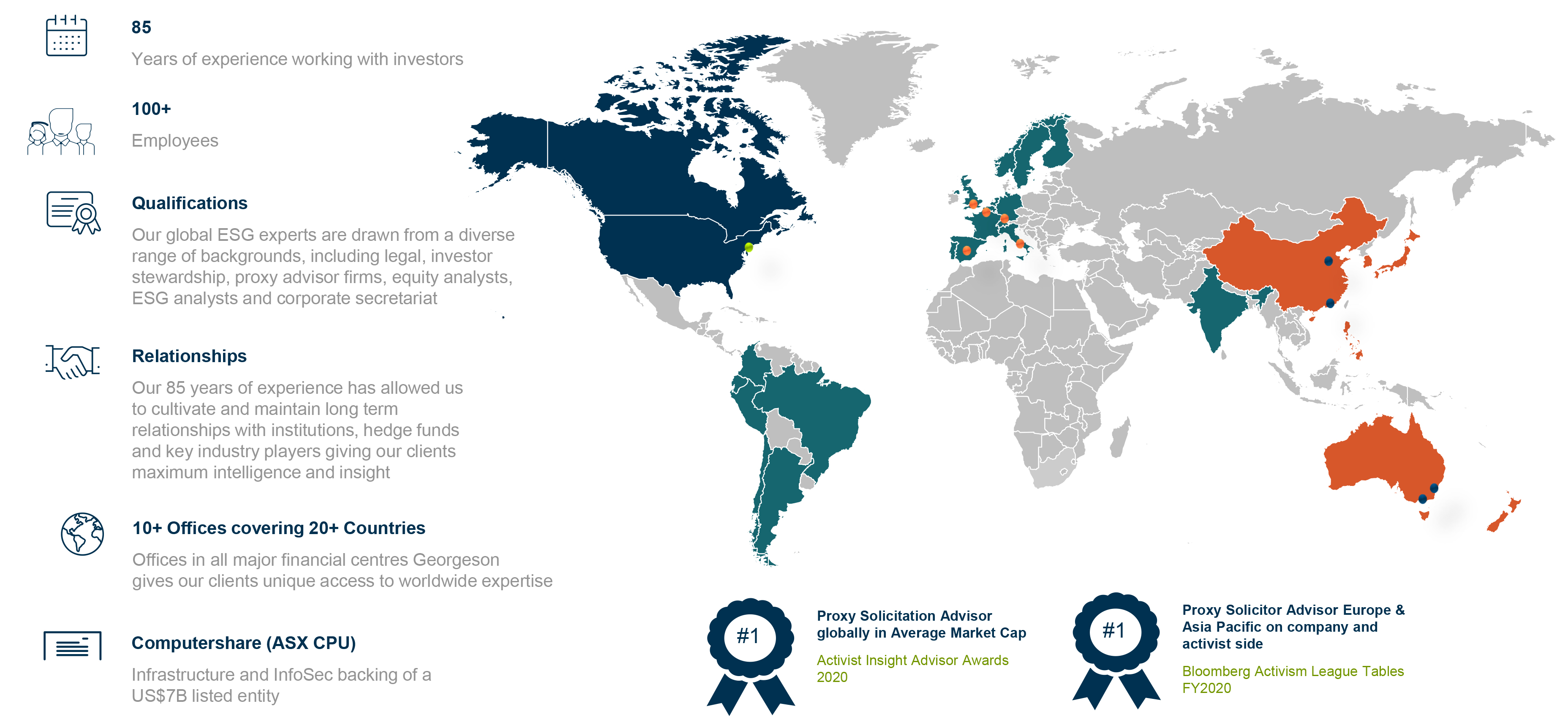
Georgeson has been providing strategic shareholder communications and corporate governance advice to boards, executives, and investors worldwide for over 85 years.
Clients rely on our services due to the depth and breadth of our experience in the identification, communication and mitigation of risk, and our commitment to our client’s achievement of their corporate objectives. Georgeson’s wealth of experience enables us to deliver best-in-class ESG advice and investor-focused solutions. Capital is global and with offices in all major financial centres, Georgeson gives our clients unique access to worldwide expertise. Furthermore, ESG becomes a strategic, competitive advantage when our team applies its data-driven, analytical approach and relationships across the corporate governance spectrum to your company’s specific concerns.
Well-crafted and thorough TCFD reporting maximises the credit you receive for your climate-related achievements. Whether you choose an integrated report, website disclosure or stand-alone TCFD report, we’ll ensure you effectively communicate your successes to internal and external stakeholders, with a particular focus on your investors’ expectations and priorities.
Of course, it is not just TCFD reporting that is being demanded of companies and in some cases, it may not be the most relevant or important ESG-related disclosure. Today’s investors are increasingly focused on a more holistic approach towards ESG risks and opportunities of the companies in which they invest. Hence, Georgeson assists our clients in the development or refinement of an ESG Disclosure Strategy as well as an implementation plan that aligns with Board and institutional investor ESG reporting expectations.
Georgeson understands the expectations of the market as to what information should be reported on and how. To meet these expectations, companies must understand what ESG information is currently being used by the market and what improvements can be made. To make these improvements companies must collaborate across the organisation, from the board and senior management to the legal, human resources, risk management and investor relations teams among others. In addition to developing your disclosure, Georgeson assists in establishing the processes and policies on how to communicate necessary information as well as advising on the software tools available to clients to assist in managing and reporting on the information extracted.
How we help:
- Conduct internal stakeholder interviews to gather information for reporting purposes.
- Advise on content to achieve effective communication to internal and external stakeholders, with a particular focus on expectations and priorities.
- Draft disclosure aligned with investor-favoured frameworks and standards that are tailored to a company’s ESG goals.
- Provide comprehensive project management and report design services.
Contact us
Mariana Marabini
Corporate Governance Associate
P: +61 2 8216 5716
M: +61 487 581 315
E: mariana.marabini@georgeson.com