Foreign institutional investors and investment trusts hold around 46% of Japanese-listed equities
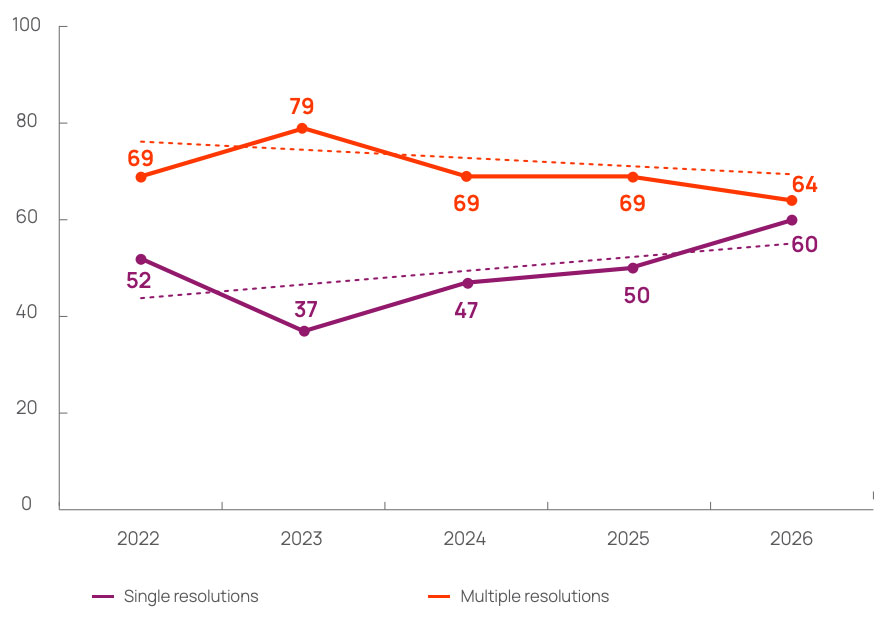
TOKYO AND LONDON, 5 November 2026 – Sixty Nikkei 225 companies faced a single contested resolution during the 2026 AGM season, 20% more than the 50 recorded in 2025, even as the total number of contested resolutions fell, according to Georgeson.
Georgeson’s 2026 Japan AGM Season Review, produced in partnership with Japan Shareholder Services (JSS), found that investor opposition spread across a broader range of Nikkei 225 companies.
The overall number of contested resolutions, defined as those receiving shareholder opposition of 10% or more, declined.
Shareholder opposition shifts across Nikkei 225 companies
The longer-term data show diverging trends. The number of Nikkei 225 companies that received a single contested resolution increased from 37 in 2023 to 60 in 2026.
By contrast, the number of companies facing multiple challenges fell from 79 in 2023 to 64 in 2026. Overall, the number of contested resolutions across the Nikkei 225 fell to 296 from 397 in 2025.
Single vs multiple contested votes – Companies with support <90%
Director election resolutions accounted for 89.1% (246) of all contested management resolutions, followed by statutory auditor elections at 4.7% (13).
Paul Murphy, Head of Governance and ESG Advisory for APAC at Georgeson, said: “Despite the vast majority of management resolutions passing this year, investor opposition is spreading across a broader range of Japan’s largest companies.
“Director elections remain the clearest indicator of investor concerns around board accountability, independence and capital allocation, with one failed director election this year within the Nikkei 225.
“The increasingly demanding voting environment means that companies heading into 2027 will need to understand who holds voting influence, assess how closely their governance and strategy align with investor expectations and engage proactively with investors to understand and address their concerns.”
Ownership changes reshape Japan’s activism landscape
The report links this broader spread of investor opposition to longer-term changes in the ownership of Japanese-listed companies and the country’s growing activism market.
Foreign institutional investors and investment trusts hold around 46% of Japanese-listed equities as of 2025, up from 7% during the early 1980s, while domestic corporations, banks and insurers have sharply reduced their holdings.
Georgeson observed that this shift has been accompanied by a reduction in traditional cross-shareholding protections and an increase in activism across Japan-listed companies.
As a result, Japan is now the world’s second-largest market for activist campaigns after the US, according to the report.
Cas Sydorowitz, Head of Georgeson, said: “Activism has increased materially among Japanese companies outside the Nikkei 225, with investors focusing more closely on corporate governance concerns in the world’s second-largest market for activist campaigns.
“Governance reforms and changing ownership patterns mean that investors are increasingly willing to use their votes to press for change at Japanese company AGMs.
“Based on the current data, we’ll likely see even more activist campaigns as foreign investors look to unlock greater shareholder value from companies.”
Leading shareholder proposals gain support
The report identifies rising support for the leading shareholder proposals as a further sign of investors’ growing willingness to press for change at Japanese companies.
Average support for the highest-supported shareholder proposal reached 43.1% during the 2026 AGM season, up from 40.0% in 2025 and 35.2% in 2024.
If this trend continues, a shareholder proposal could receive majority support at a Nikkei 225 company and pass in the future.
Further findings and governance insights
The 2026 Japan AGM Season Review also includes:
- 276 contested board-sponsored resolutions overall, a slight decline from 287 during 2025.
- 8.7% (11) of the 126 director compensation resolutions put forward by Nikkei 225 companies this year were contested, a slight proportional decline from 12.4% (16) last year.
- Average shareholder support across all compensation resolutions remained the same at 98.0% this year and 98.1% in 2025.
- Interviews with senior representatives from the International Corporate Governance Network, Northern Trust Asset Management and the Tokyo Stock Exchange.
- Analysis of voting policy changes by proxy advisers ISS and Glass Lewis.
- An overview of corporate governance regulatory and policy developments in Japan.
The report, which also contains detailed case studies of activism at three prominent Nikkei 225 issuers, is available at 2026 Japan AGM Season Review.