 Each proxy season brings increasing uncertainty and complexity. Without your knowledge, activist investors may be scrutinizing your company's corporate governance practices and disclosure efforts.
You need a partner who can advise you on how to communicate with investors and proxy advisors on the issues that matter to them, so you can be prepared. Georgeson continuously monitors the activism landscape and will help you control your outcomes, from annual meetings to activist investor scenarios, by providing expertise and strategies so you can:

Act on Intelligence

Execute with Excellence

Prepare for Possibilities
DIRECTOR ELECTIONS
Is your board composition making you a target for activism?
Investors continue to take a more critical look at director elections, and consistent with the trend Georgeson identified in 2018, support levels continued to trend downwards in 2019. Companies need to be aware of the vulnerabilities in their board structure and consider these board-related topics that appear to have generated the majority of negative votes against directors:
- Overboarding, with the concern that directors serving on several boards may not be able to dedicate themselves to the roles they’ve been elected to serve.
- Board composition, the focus continues with respect to creating boards that are diverse in age, gender, race, ethnicity, background, experience and skills to ensure they are composed appropriately.
- Board responsiveness and accountability, with boards expected to be responsive to shareholder votes and specific investor concerns.
BOARD CHAIR AND CEO INDEPENDENCE
Independent chair proposals come into play when other perceived governance issues are under scrutiny.
In instances where one individual holds the combined role of board chairman and CEO, shareholder proposals seeking to separate these responsibilities into positions held by different individuals represented over 70% of the board-related proposals that reached a vote this proxy season.
Independent chair proposals often come into play when other governance issues are under scrutiny. In some cases, investors use these proposals to express concern with a company’s wider approach to governance matters, such as a company’s climate strategy, not addressed by a separate ballot item.
Voting support for this proposal is also often affected by the clarity of a company’s disclosure regarding its rationale for, and duties of, a lead independent director. Activists may claim that separating these roles could equalize the distribution of oversight and control.
Although no proposals received majority shareholder support in the 2019 proxy season, they seem to be gaining traction – having approached or crossed a 40% support threshold at several companies.
ENVIRONMENTAL, SOCIAL AND GOVERNANCE (ESG) ISSUES
Improve your ESG strategy to protect your company from activism.
Public company boards and management must understand the ESG landscape relevant to their organizations. Investors expect that companies should articulate their ESG issue-related risks and opportunities in the context of long-term value creation. Knowing the ESG disclosures that are most important to your investors can help you mitigate risk in these areas.
As the 2020 proxy season approaches, the importance of culture and corporate purpose have emerged as focus points for investors. In recent years there has been increased investor and public scrutiny on workplace issues.
Shareholder proposals related to addressing sexual harassment reporting or prevention and gender pay gap emerged or gained prominence in 2019. State Street Global Advisors has shared its approach on corporate culture in a letter to boards. In his 2018 and 2019 Letters to CEOs, BlackRock CEO Laurence Fink discussed the importance of purpose and how it aligns with company profits. Furthermore, in August 2019, the Business Roundtable issued a statement that corporate purpose includes all stakeholders — including customers, employees, suppliers, communities and investors.
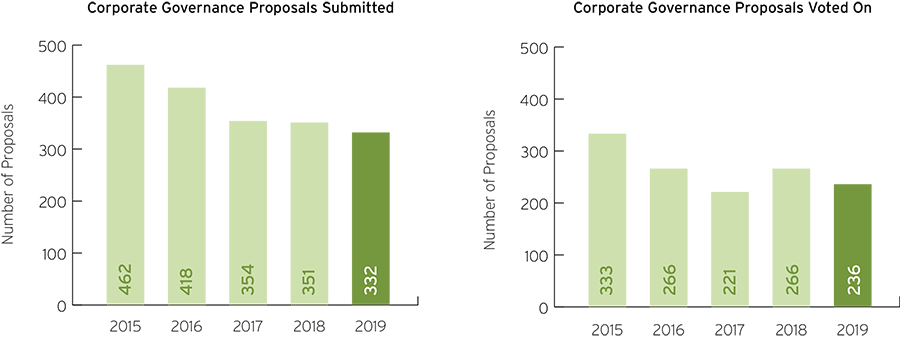
Source: Georgeson's 2019 Annual Corporate Governance Review
SAY-ON-PAY
Instances of low support for say-on-pay can lead to perceived governance vulnerabilities and activism.
Voting against say-on-pay proposals is how shareholders express concerns regarding a company’s pay practices. While year-over-year vote support for these proposals remains high, companies that receive low support (fail or in the red-zone) may want to evaluate these pay practices that are frequently perceived as negative:
- Misalignment between pay and company performance
- Special awards/mega-grants
- Benchmarking practices
- Problematic pay practices
- Non-performance based equity
- Shareholder outreach disclosure
- Rigor and appropriateness of performance goals
To learn more about the most recent trends in corporate governance and how we can help you prepare for all possibilities at your shareholder meetings and in the boardroom, contact us.