Key trends shaping shareholder proposals, voting outcomes, and activism
Investor influence is harder to earn and more critical to win, making early intelligence, engagement and trusted advisory essential for IR Pros and Boardroom Pros navigating the 2026 proxy season.
Success increasingly depends on understanding who holds influence, separating signal from noise, and turning decision-useful intelligence into proactive engagement that shapes outcomes.
The early 2026 proxy season through May 15 reflects a more issuer-favorable but increasingly complex environment, characterized by:
- Declining shareholder proposal volume
- Continued strong support for management
- A clear pivot toward governance-focused issues
- A regulatory backdrop introducing greater uncertainty and potential risk into the process
- A shift from broad-based activism to more targeted, strategic investor influence.
The implications for IR Pros, Boardroom Pros, and corporate issuers
1. Lower volume does not mean lower risk
- Fewer proposals, but greater strategic focus
- Governance proposals present higher potential impact
- SEC ‘no objection’ posture shifts risk to issuers
2. Early engagement is increasingly critical
- Companies that engage earlier and more consistently are better positioned to:
- Anticipate investor concerns
- Reduce proposal escalation
- Secure support at vote
3. Governance is a boardroom-level influence issue
- Board composition, shareholder rights, and governance structures are central to investor evaluation
- These areas require proactive narrative and positioning
4. Disclosure is a strategic engagement tool
- With more proposals going to a vote:
- Proxy disclosure must clearly articulate company rationale and help investors understand the context behind board and management decisions.
- Messaging must directly address investor concerns
5. Regulatory change is driving complexity
- The evolving SEC environment introduces:
- Greater uncertainty
- More issuer accountability
- Increased likelihood of proposals proceeding to vote
Taken together, the trends underscore why public companies need an integrated approach to intelligence, engagement and advisory, that helps separate signal from noise, identify who holds influence, engage investors proactively, and influence outcomes with greater confidence.
2026 proxy season at a glance
Proposal volume and mix
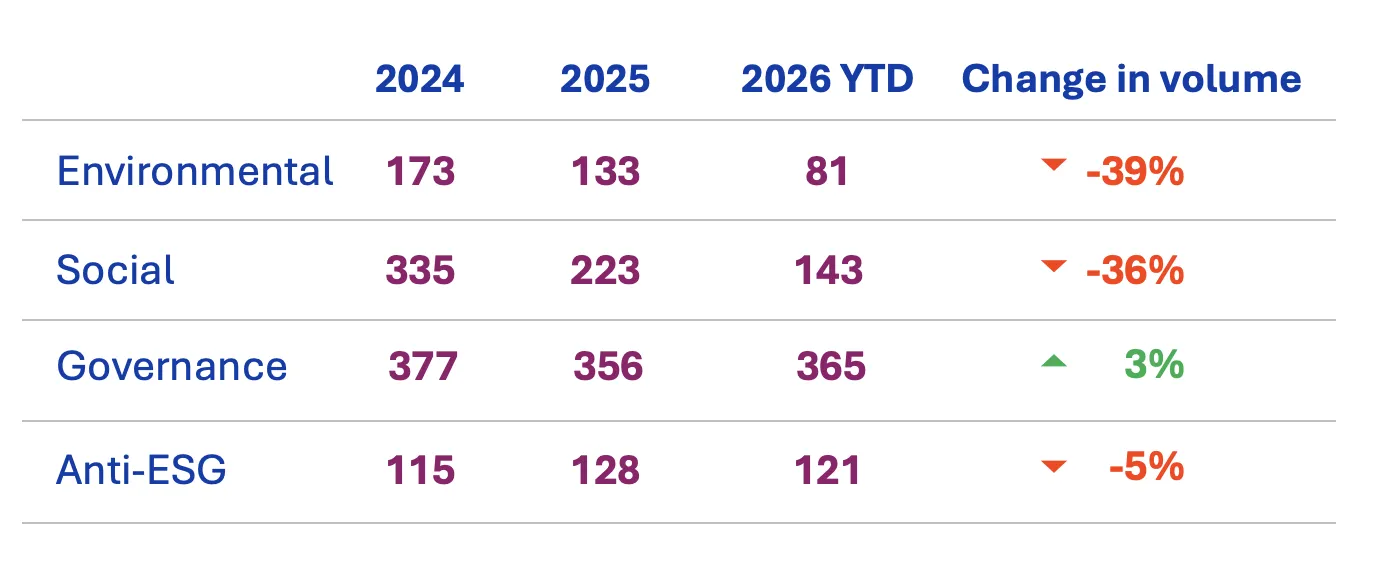
- 710 total shareholder proposals, down from 840 in 2025 and 1,000 in 2024
- Approximately 15 percent year-over-year decline
Composition shift:
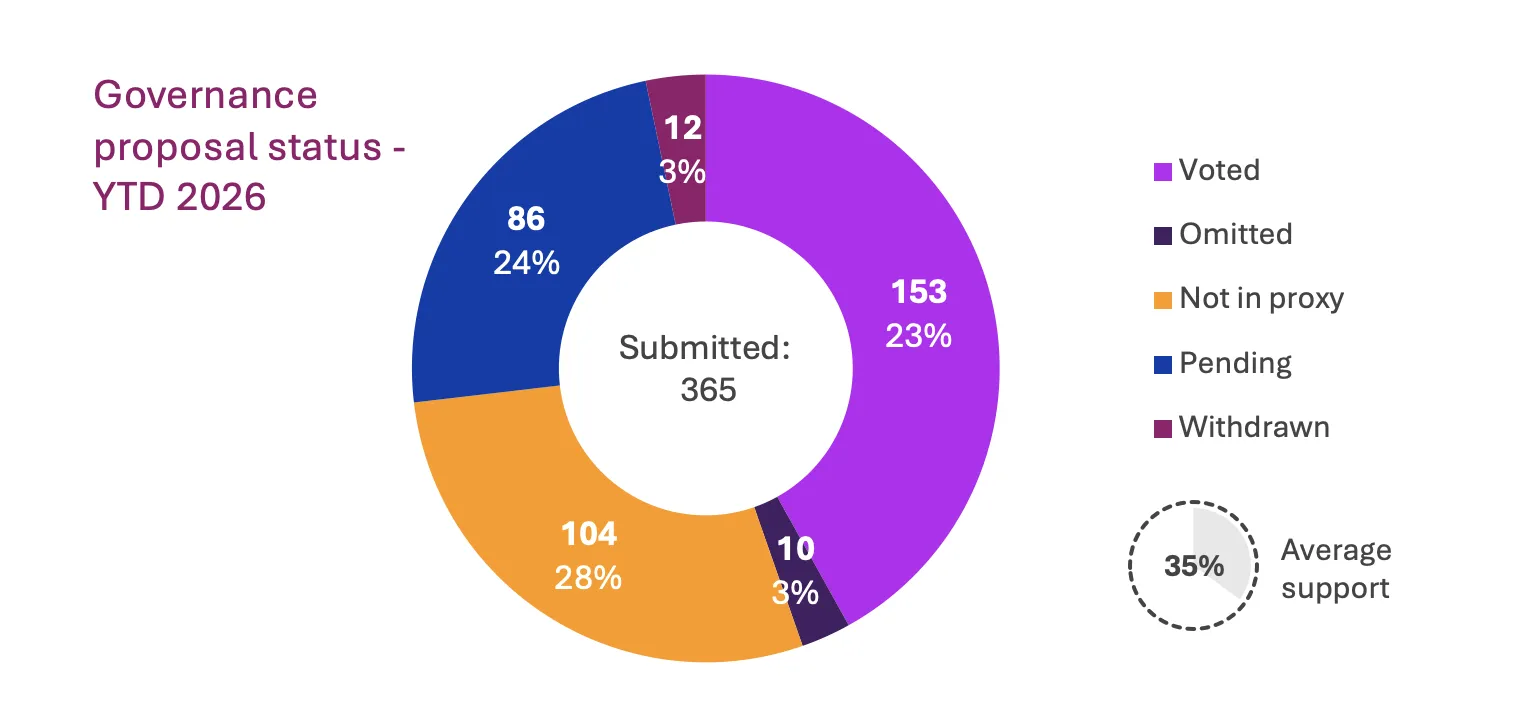
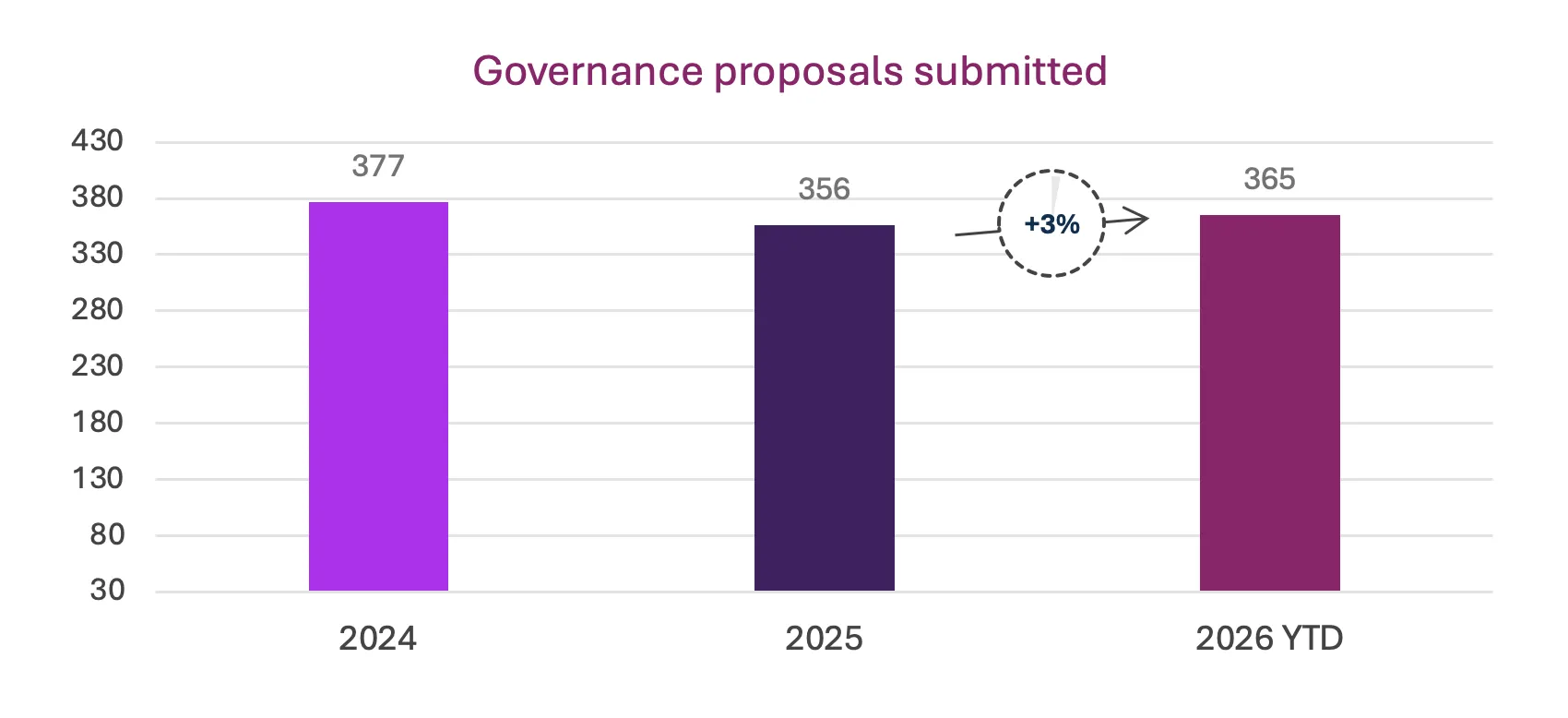
- Governance proposals: approximately 51 percent of total, now the dominant category
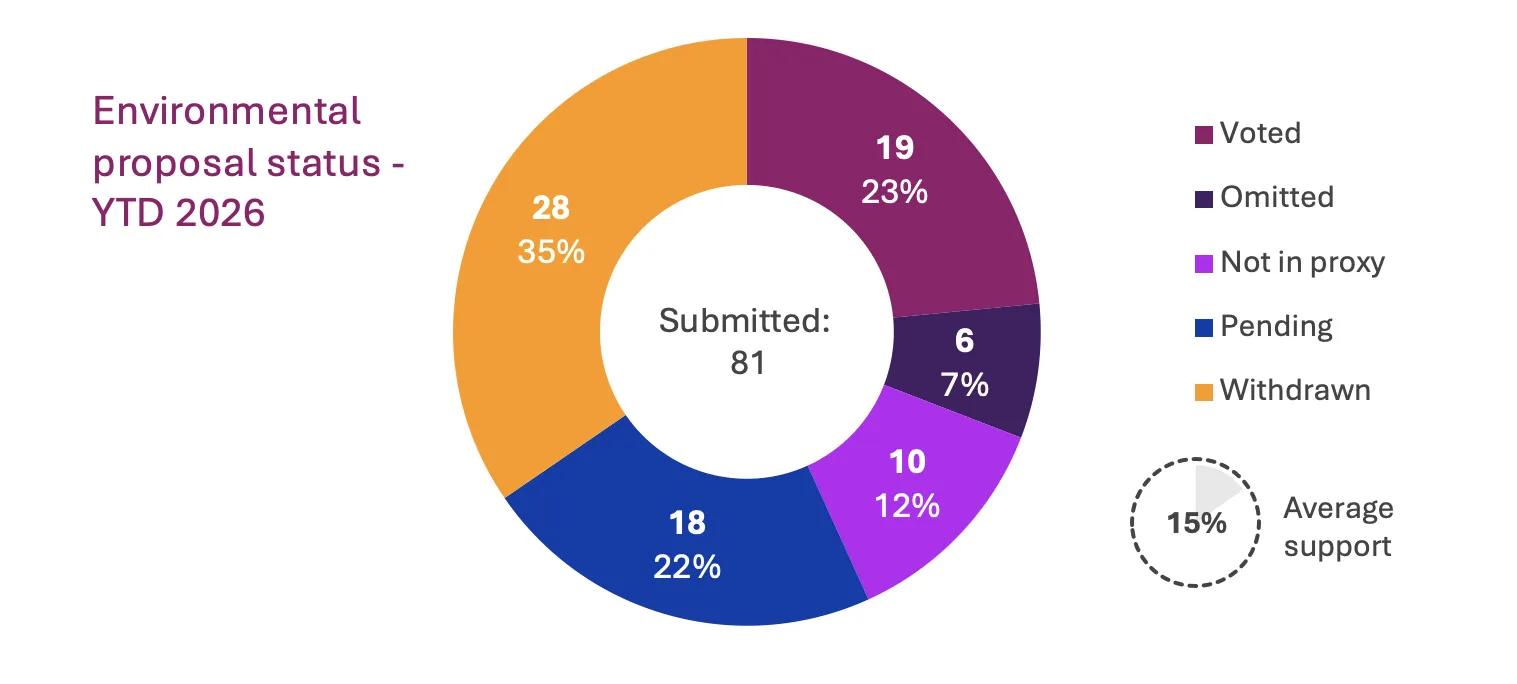
- Environmental proposals: 97 (down from 147)81 (down from 133)
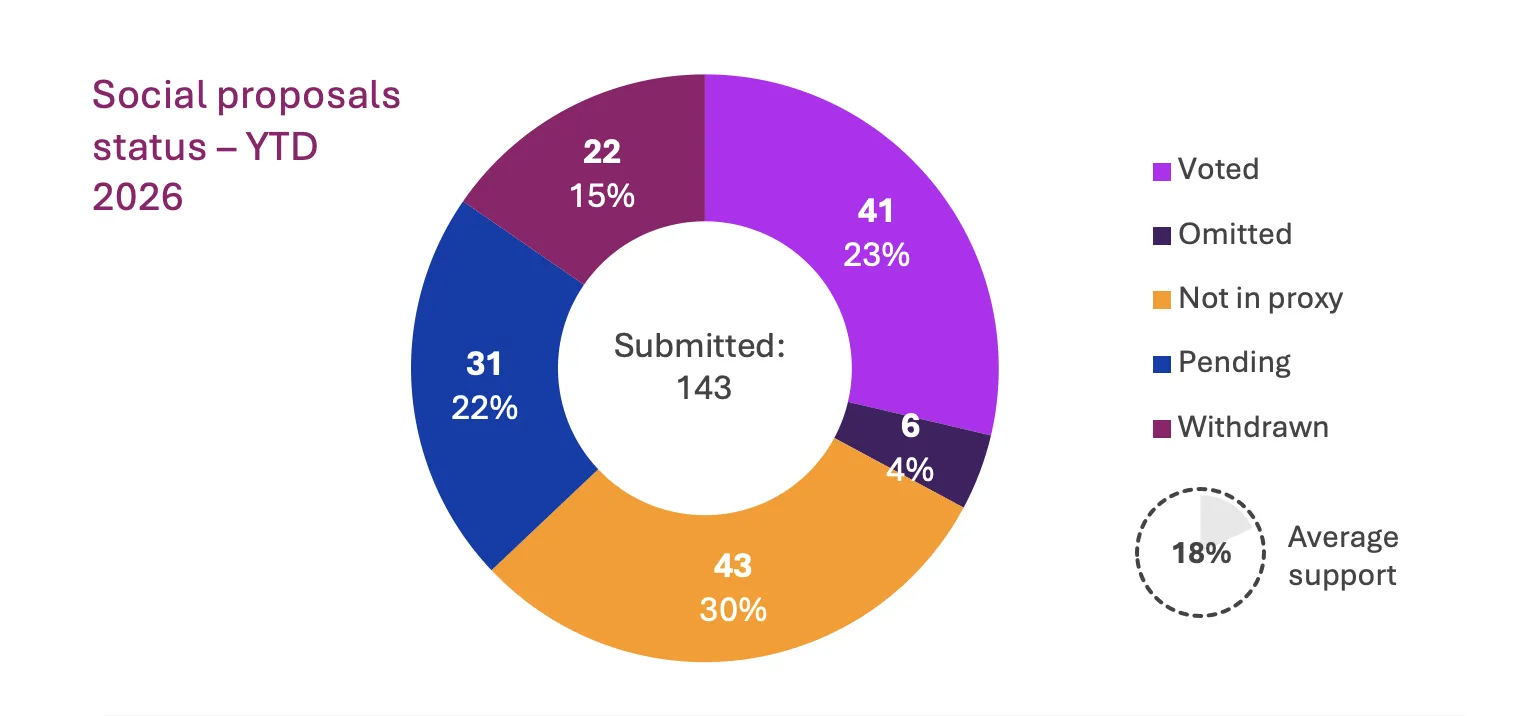
- Social proposals: 209 (down from 313)143 (down from 223)
- Anti-ESG proposals: stable at approximately 120+
Insight: Governance topics are showing a relative increase in importance, while environmental and social proposals are declining. For Boardroom Pros, the shift reinforces the need for clearer governance narratives, earlier risk detection, and stronger shareholder alignment before issues escalate to a vote.
Voting outcomes
- Director elections: approximately 95.7 percent average support
- Say-on-pay: approximately 92.0 percent average support
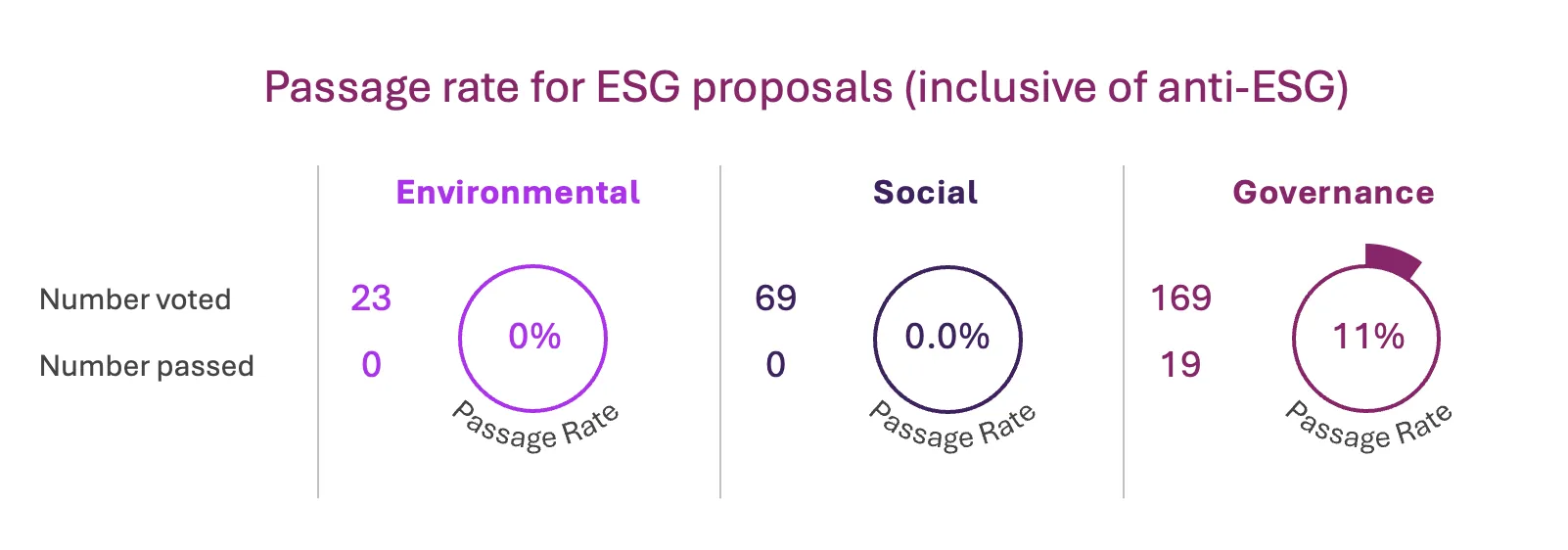
- Environmental and social proposals: 0 percent pass rate to date
Insight: Management continues to receive strong investor support across key votes, even as proposal activity evolves.
Regulatory impact
- Changes to SEC processes are reshaping how proposals are handled
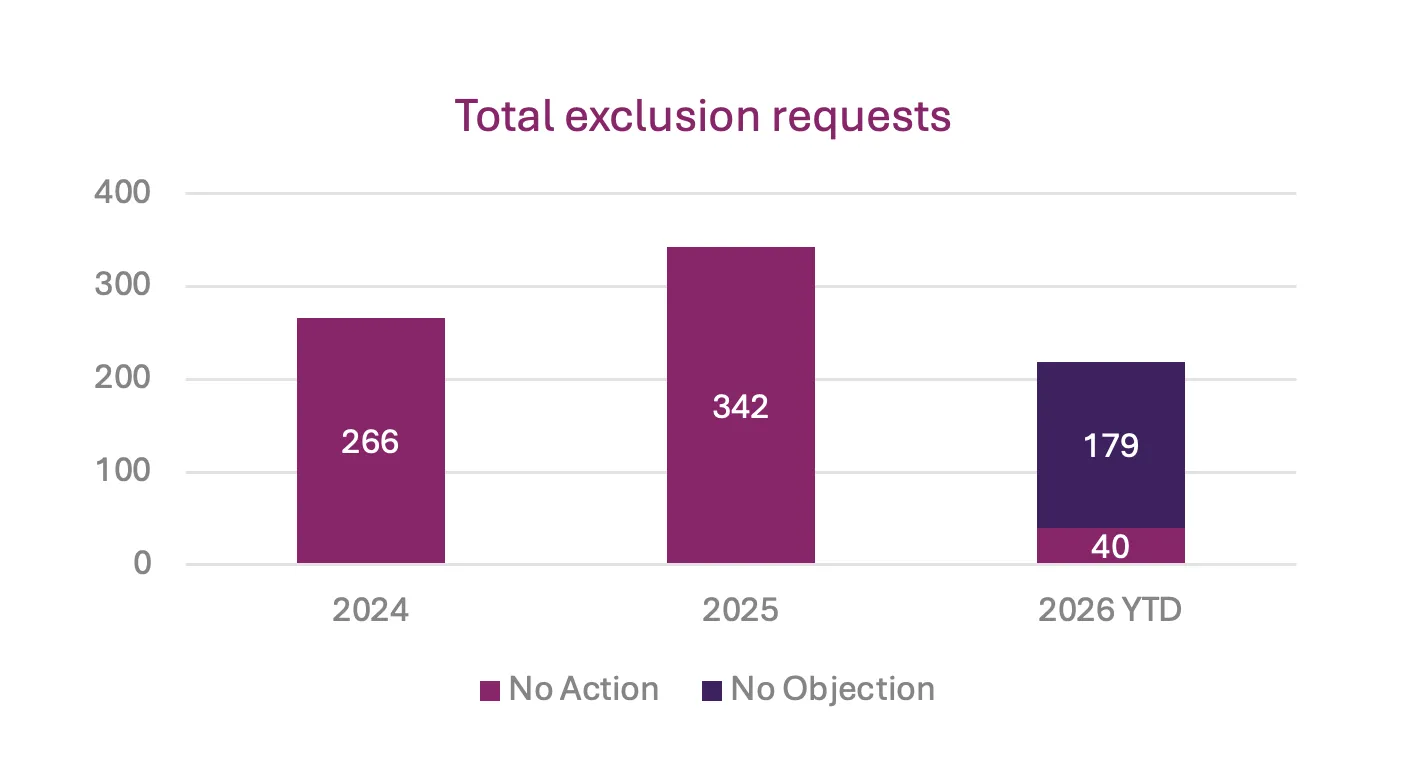
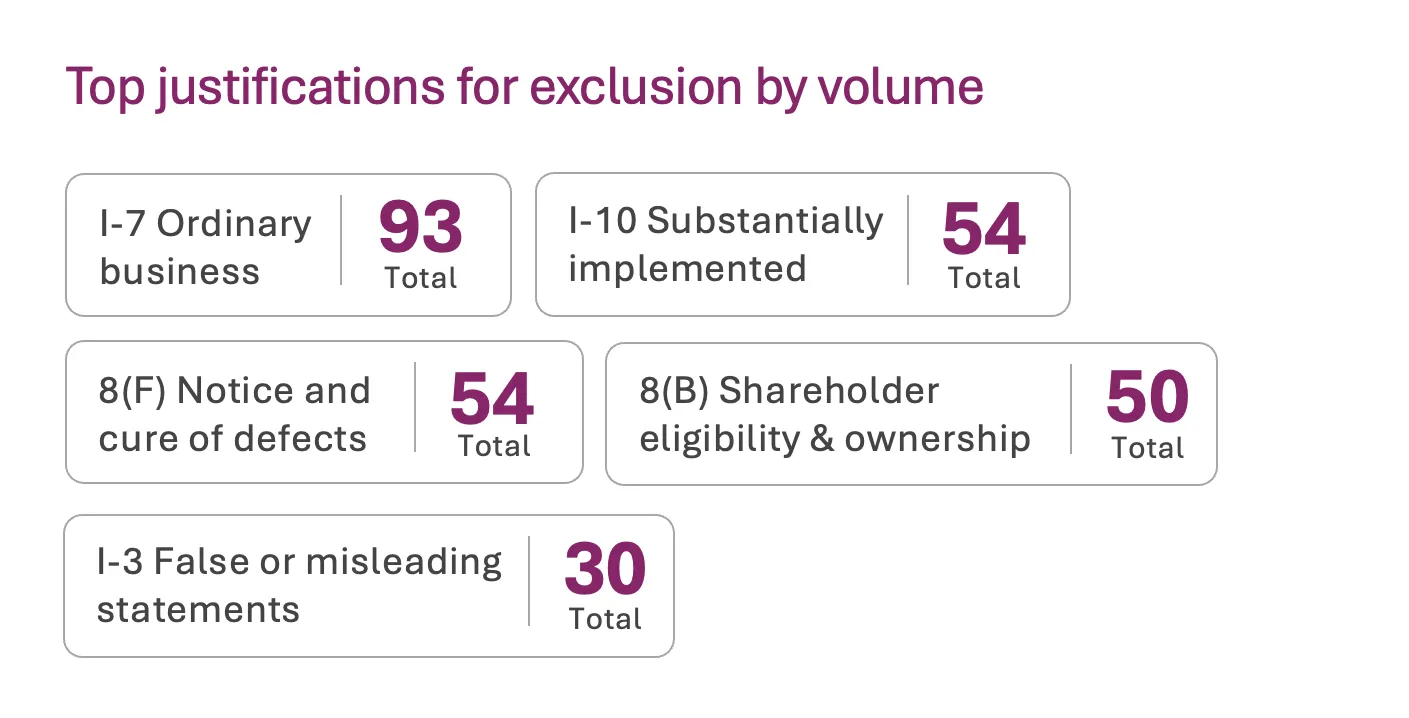
- The overall proportion of proposals not voted on remains consistent with prior years, suggesting that issuers are continuing to exclude a comparable amount of proposals under the new ‘no objection’ framework.
Key data point:
- The number of lawsuits being filled by proponents to challenge issuer decisions to exclude proposals under the new ‘no objection’ framework.
This increases the need for decision-useful intelligence and trusted advisory that helps issuers engage more strategically and proactively.
- Greater responsibility on issuers to assess and respond to proposals
- Increased uncertainty in the proposal exclusion process
- More proposals progressing to shareholder votes
Key governance trends
Governance proposals are now the primary focus of shareholder activity.
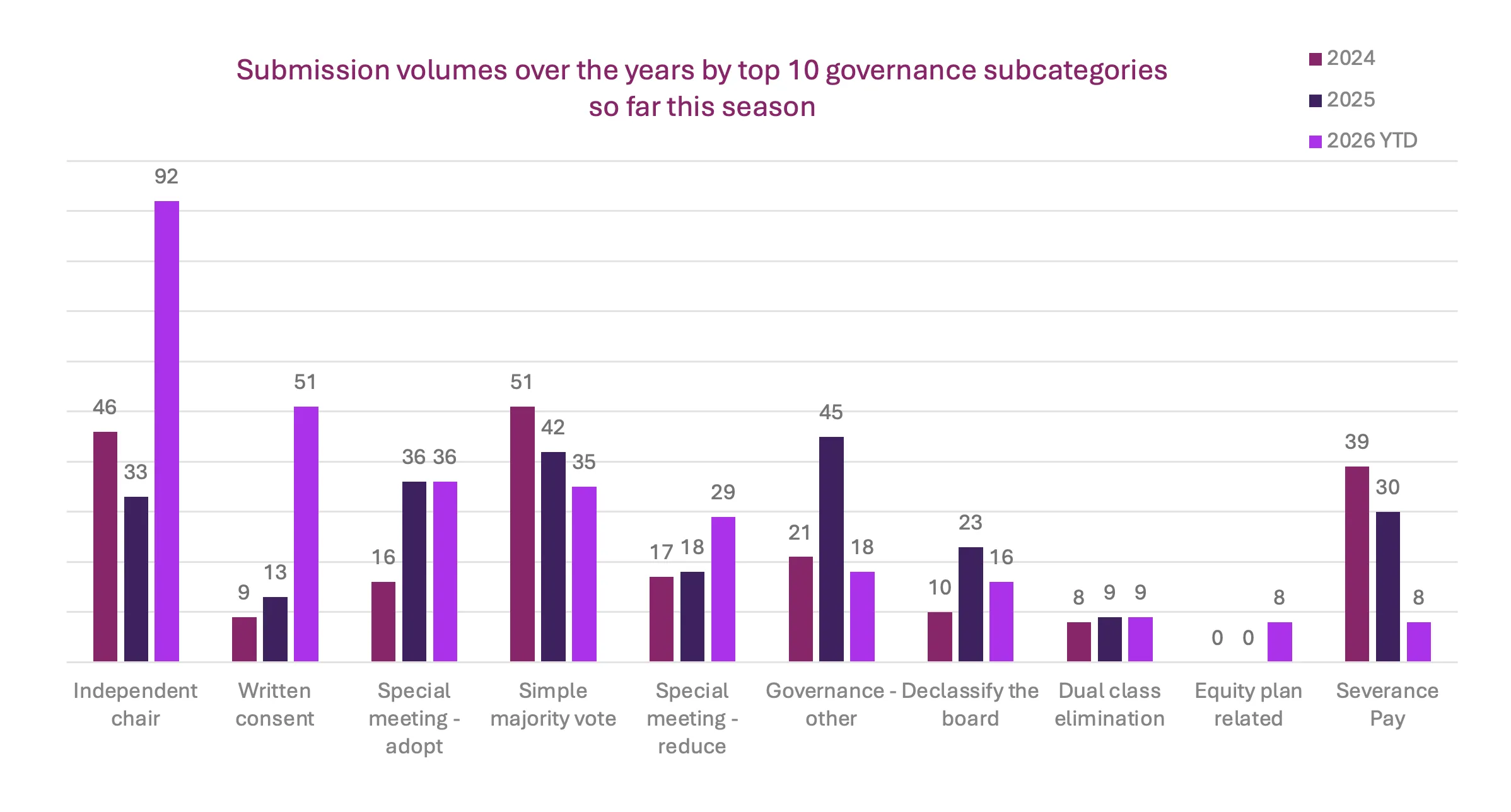
Fast-growing proposal topics:
- Independent chair: up 179 percent (92 from 33)
- Written consent: up 292 percent (51 from 13)
- Special meeting threshold reduction: up 61 percent (29 from 18)
Declining topics:
- Severance proposals down 73 percent (8 from 30)
- Director resignation proposals down 63 percent (7 from 19)
- No clawback proposals submitted (0 from 15)
Insight: Investor attention is shifting toward board structure, shareholder rights, and governance control mechanisms. For Boardroom Pros, governance has re-emerged as one of the clearest indicators of investor priorities and a critical area for proactive engagement. These issues sit squarely in the Boardroom Pros agenda, where governance risk, investor sentiment, and vote outcomes increasingly converge.
ESG and anti-ESG dynamics
- ESG-related proposals declined significantly in volume
- Anti-ESG proponents are increasingly using governance frameworks to advance agendas
- No environmental or social proposals have passed
Notable trend:
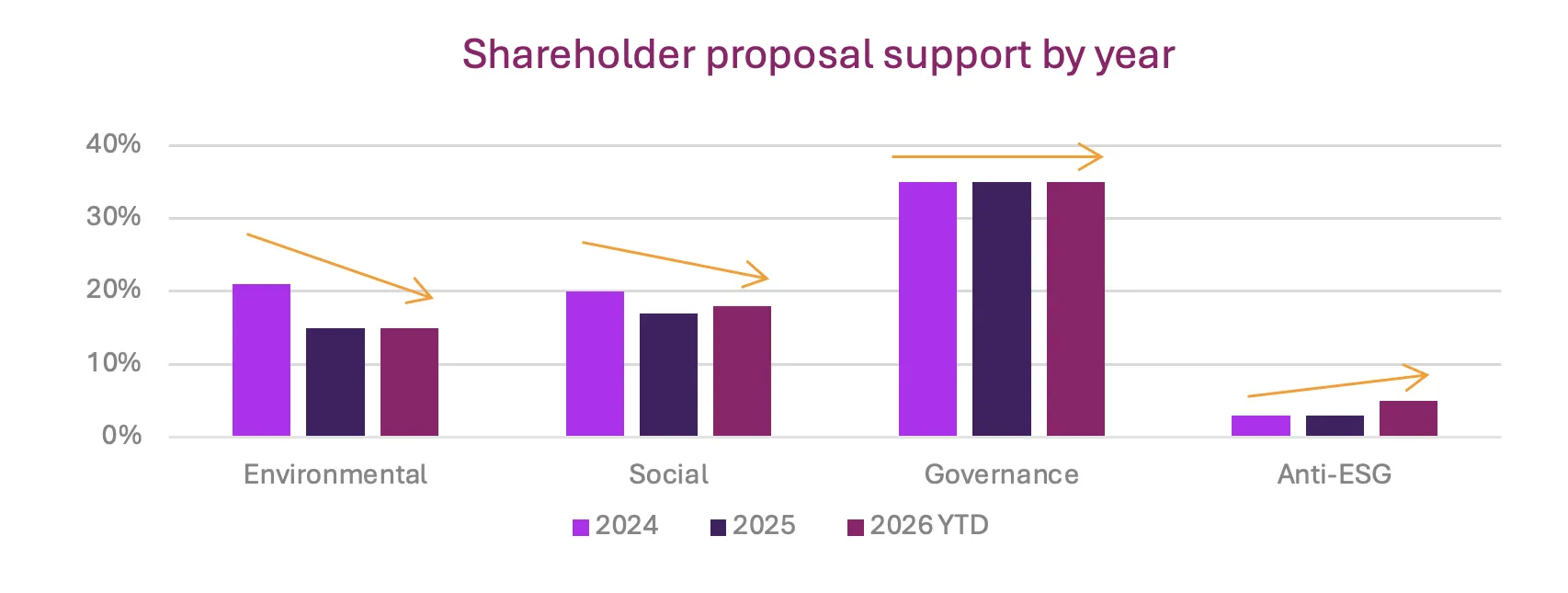
- Independent chair proposals from anti-ESG proponents are receiving approximately 25 percent support, compared to historical norms of anti-ESG proposals in general, which is closer to 5 percent
Insight: The debate is transitioning from ESG positioning to more governance-focused engagement and investor influence.
Activism trends
- Overall campaign volume has declined
- Campaigns are becoming:
- More targeted
- More strategic
- More effective
Key characteristics:
- Focus on fewer, high-impact objectives
- Increased emphasis on board composition and governance levers
- Greater precision enabled by proxy mechanics
Insight: Companies face fewer but more consequential activist situations. In a lower-volume but higher-stakes activism environment, issuers need sharper signals, earlier threat detection and trusted guidance that helps separate signal from noise and supports more confident decisions.
Looking ahead
- Will new channels for shareholder communication increase visibility of shareholder concerns outside traditional filings?
- How will activism trends evolve, including the use of ‘vote no’ campaigns and settlement dynamics?
Bottom line
The early 2026 proxy season demonstrates that:
- Proposal volume is declining, but risk, scrutiny and strategic focus are increasing
- Governance has re-emerged as the central area of investor attention, while E&S interest is receding
- Management continues to receive strong support across key votes
- Activism is becoming more selective, targeted, and effective
- Regulatory developments are adding complexity and unpredictability
Engagement action plan
To successfully navigate an increasingly complex proxy environment, companies should:
- Anticipate and address governance pressure points early
- Prioritize proactive shareholder engagement
- Strengthen proxy disclosure and messaging clarity
- Prepare for high-impact, targeted activism
- Use integrated intelligence, engagement, and trusted advisory to identify who holds influence, engage strategically, and make more confident decisions
Georgeson Advisory gathered and analyzed 2026 partial year-to-date (YTD) proxy results (July 1, 2025 to May 15, 2026) from R3000 companies and compared proxy data from previous years. Prior season data in this report reflects proxy data from the full annual general meeting (AGM) season (July 1 to June 30 of the following year) of R3000 companies unless otherwise indicated. Please note that the report interchanges the term ‘year’ with ‘proxy season’ unless stated otherwise. YTD results reflect all shareholder proposals submitted and identified through May 15, 2026, including those scheduled for votes later in the proxy season. Vote results include AGMs held through May 15. The May 15 cutoff captures approximately 60% of Russell 3000 companies and, based on historical experience, subsequent vote outcomes do not typically affect aggregate averages to a material extent.