In its January 2022 Guidance on Climate-related Disclosures, State Street details its expectations on climate-related disclosure and its approach to voting and engagement on climate-related topics.
Broadly, State Street considers alignment with the Sustainable Accounting Standards Board (SASB) as a reporting disclosure minimum all companies should achieve. Beyond SASB, State Street is looking for companies to enhance adoption of Task Force on Climate-Related Financial Disclosure (TCFD)-aligned reporting and expects all portfolio companies to publicly disclose climate-related information in accordance with TCFD’s four pillars: Governance, Strategy, Risk Management, and Metrics and Targets.
Additional disclosure expectations for companies in carbon-intensive sectors
In its recent guidance, State Street further details heightened reporting requirements for carbon-intensive sectors, which they define as oil and gas, utilities, and mining sectors. For companies in these sectors, as of 2022 State Street expects:
Interim greenhouse gas (GHG) emissions reduction targets to accompany long-term climate ambitions
Regarding interim GHG emissions reduction targets, State Street expects companies to adopt short- and/or medium-term GHG emissions reduction targets. State Street expects companies that commit to long-term ambitions, such as net-zero by 2050, also commit to interim targets to provide accountability for ultimately meeting long-term goals.
Discussion of impacts of scenario-planning on strategy and financial planning
State Street expects companies in carbon-intensive sectors to conduct climate scenario-planning exercises as a way to “better understand and position themselves to respond to climate-related risks and capitalize on opportunities.” State Street further encourages companies to link scenario-planning to strategic outcomes, rather than treat such planning as an isolated exercise. State Street is not prescriptive with regards to the types of scenario-planning companies need to prepare, but encourages multiple scenarios and believes it best practice to consider a scenario aligned with the Paris Agreement or a net-zero by 2050 pathway. For companies that have previously performed scenario analysis using 2°C scenarios, it is important to take note of this policy change.
Use of carbon pricing in capital allocation decisions
On the topic of carbon pricing1, State Street expects companies in carbon-intensive sectors to incorporate climate considerations into capital allocation decisions. Specifically, State Street encourages disclosure of the average and/or range of carbon price assumptions used. In this regard, companies may be well-served by looking to peers with significant operations within the European Union and Canada, where carbon pricing is already mandated.
Disclosure of Scope 1, 2, and material categories of Scope 3 emissions
State Street expects carbon-intensive companies to disclose Scope 1 and 2 emissions, along with material categories of Scope 3 emissions, as defined by the GHG Protocol’s Corporate Value Chain (Scope 3) Accounting and Reporting Standard. While State Street acknowledges that Scope 3 reporting has “inherent challenges,” the guidance emphasizes that Scope 3 is an area of increased focus for investors. State Street considers independent assurance of GHG emissions reporting a best practice and encourages companies to “assess and begin implementing actions to achieve incremental Scope 3 emissions reductions where feasible.”
Disclosure expectations for effective climate transition plans
In the guidance document, State Street provides details on its expectations on climate transition planning disclosures applicable to all companies beginning in 2023. Furthermore, SSGA notes that as signatory to the Net Zero Asset Managers initiative (NZAM), it has a “responsibility to provide portfolio companies with clarity on [its] expectations for effective climate transition plan disclosure.” (For more details on the NZAM initiative, see our previous note here).
State Street expects companies to address “core criteria” when developing climate transition plans, as noted in the table below:
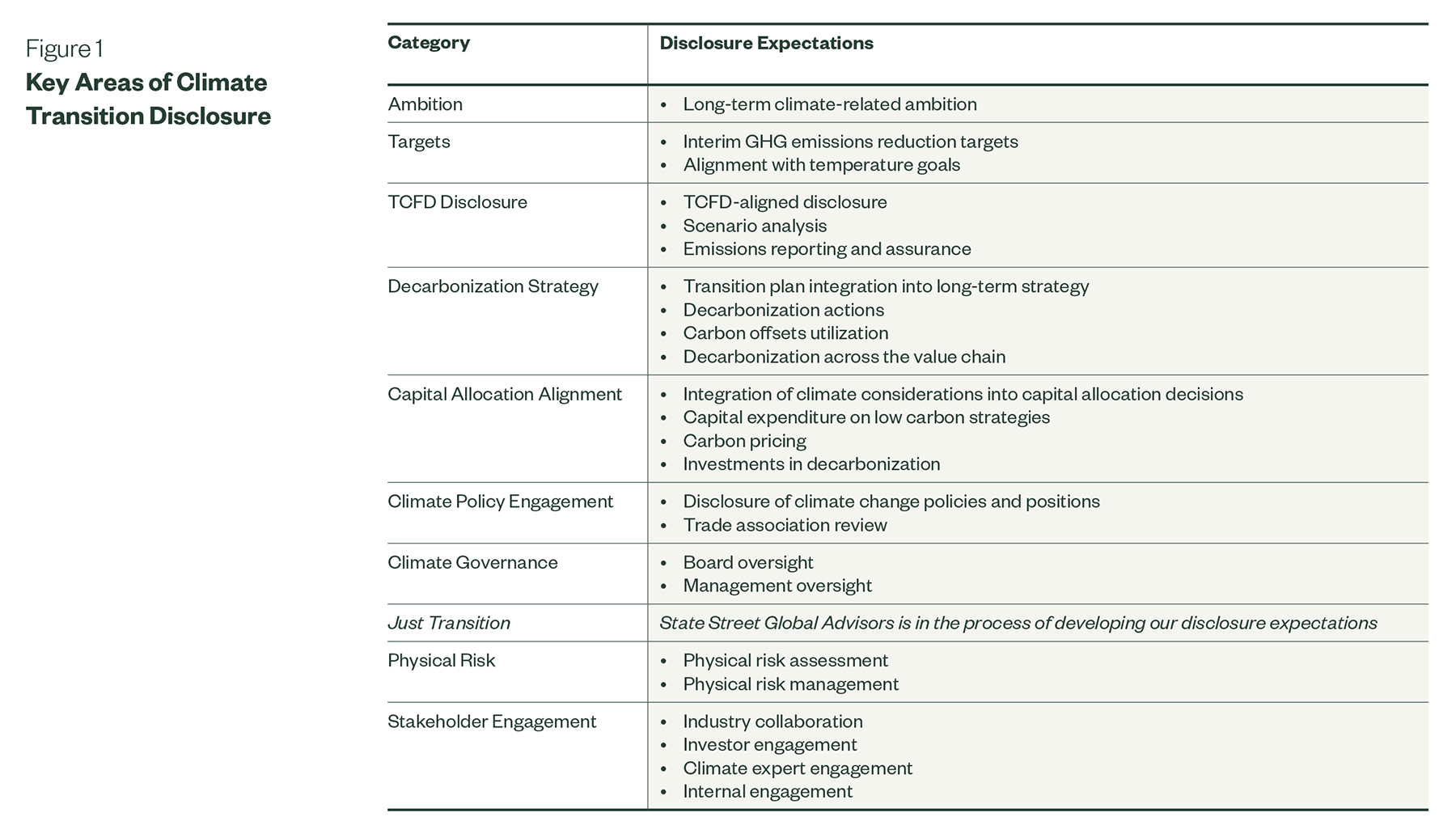
Source: State Street Guidance on Climate-related Disclosures, page 3
State Street provides more details on its expectations across these 10 categories – which generally align with those found in the Institutional Investors Group on Climate Change (IIGCC) Net Zero Investment Framework and the Climate Action 100+ Net-Zero Company Benchmark – in a separate bulletin, Disclosure Expectations for Effective Climate Transition Plans.
Voting
As it relates to potential impacts on proxy voting, State Street indicates it will discuss climate-related expectations directly with companies during engagements, with a focus on companies and industries that State Street considers having the greatest risk and opportunity. However, State Street notes: “If we encounter laggards that are not making sufficient progress regarding climate-related disclosure as a result of our engagements, we will consider taking action using our votes, either by supporting relevant shareholder proposals or voting against directors at an upcoming shareholder meeting.”
Director elections
Beginning in 2022, for companies in the S&P 500, S&P/TSX Composite, FTSE 350, STOXX 600, and ASX 100 indices, State Street will start voting against directors at companies that, in its view fail to provide sufficient disclosure in accordance with the TCFD framework. This includes disclosure of board oversight of climate-related risks and opportunities, disclosure of total Scope 1 and Scope 2 GHG emissions, and targets for reducing GHG emissions. For companies that fail to meet State Street’s expectations, it may vote against the independent board leader, a new voting policy they consider “a natural escalation of [their] previously-stated expectations on climate-related disclosure and history of proxy voting and engagement on the TCFD framework.” Notably, State Street expects to continue expanding this policy in the coming years.
Beginning in 2023, State Street will hold directors accountable at companies that “fail to show adequate progress on meeting [State Street’s] climate transition disclosure expectations.”
Shareholder proposals
State Street’s Guidance on Climate-related Disclosures also notes the firm’s approach to evaluating shareholder-sponsored proposals. State Street will evaluate such proposals on a case-by-case basis and consider several factors, including the reasonableness of the proposal, alignment with TCFD and SASB, emergent market and industry trends, peer performance, and dialogues with company management, boards, and other stakeholders. For climate-related proposals at companies in carbon-intensive sectors, State Street will consider alignment with their aforementioned disclosure expectations.
Engagements
In the run up to implementation of its 2023 policy on holding directors accountable for climate transition disclosure, State Street is launching an engagement campaign on climate transition plan disclosure in 2022, targeting significant emitters in carbon-intensive sectors. As part of this campaign, State Street will aim to better understand a company’s climate transition plans and strategies, and gain insight on each company’s unique set of climate-related risks and strategic opportunities presented by the transition.
In addition to its proactive campaign, State Street also indicates that climate remains a core stewardship priority and provides details surrounding potential questions that all companies may be asked during engagement. State Street divides these questions across four categories: Governance, Strategy, Risk Management, and Metrics and Targets. Potential questions for each category are enumerated below. Companies planning to engage with State Street should take note of these questions and ensure they are adequately prepared to engage in dialogue across these topics.
Governance
- Where is the responsibility for climate oversight housed at the board level? How frequently does the board discuss the topic of climate change?
- How is climate — and other ESG — experience considered in the board refreshment process?
- How is the board incorporating key sustainability drivers into the performance evaluation of management?
- How does management and the board utilize external expertise to stay abreast of the emerging areas of climate?
Strategy
- How does the company integrate climate considerations into business strategy and financial planning?
- What actions are being considered to support efforts to reduce GHG emissions across the value chain, such as with suppliers and customers?
- Where does the company identify the greatest opportunities for decarbonization in the short- and medium-term?
- How does the company engage employees on the development and integration of climate efforts into corporate culture and strategy?
- For relevant industries, how does the company consider carbon pricing in project assessment and portfolio decisions?
Risk Management
- How does the company consider climate-related risks as part of overall risk management? What is the board’s role?
- Has the company assessed the potential impacts of physical risk on its assets and operations?
- How does the company manage climate-related policy risks? Has the company conducted an assessment of its stated climate positions versus those of its trade and industry associations?
- As investor interest in the intersection of environmental and social issues grows, how is the company considering emerging topics such as just transition?
Metrics and Targets
- What metrics does the company utilize to track progress on achieving its climate goals?
- What sources of GHG emissions contribute most significantly to the company’s carbon footprint?
- What are the biggest challenges facing the company in achieving its GHG emissions reduction targets?
- What are the company’s perspectives on using a lower hurdle rate or IRR for low-carbon projects?
It is important for companies to be aware of the ways investors are considering and incorporating climate-related factors into their investment decisions and engagement priorities.
For more analysis on how changing expectations towards climate may affect your company, or to better understand the rapidly adapting ESG landscape, contact Georgeson.
If you have questions or comments, please email info@georgeson.com or call (212) 440-9800
1Carbon pricing is a way to capture external costs associated with greenhouse gas (GHG) emissions and incorporate current or future regulations that would increase the cost of emissions. Internal carbon pricing is often used as an input in scenario analysis and capital allocation planning.