Shareholder activism is a means for investors to voice their concerns and opinions on the practices of the companies they invest in. Activists are often investors that own a significant stake in a company and use this position of strength to drive change and get more value for their investment.
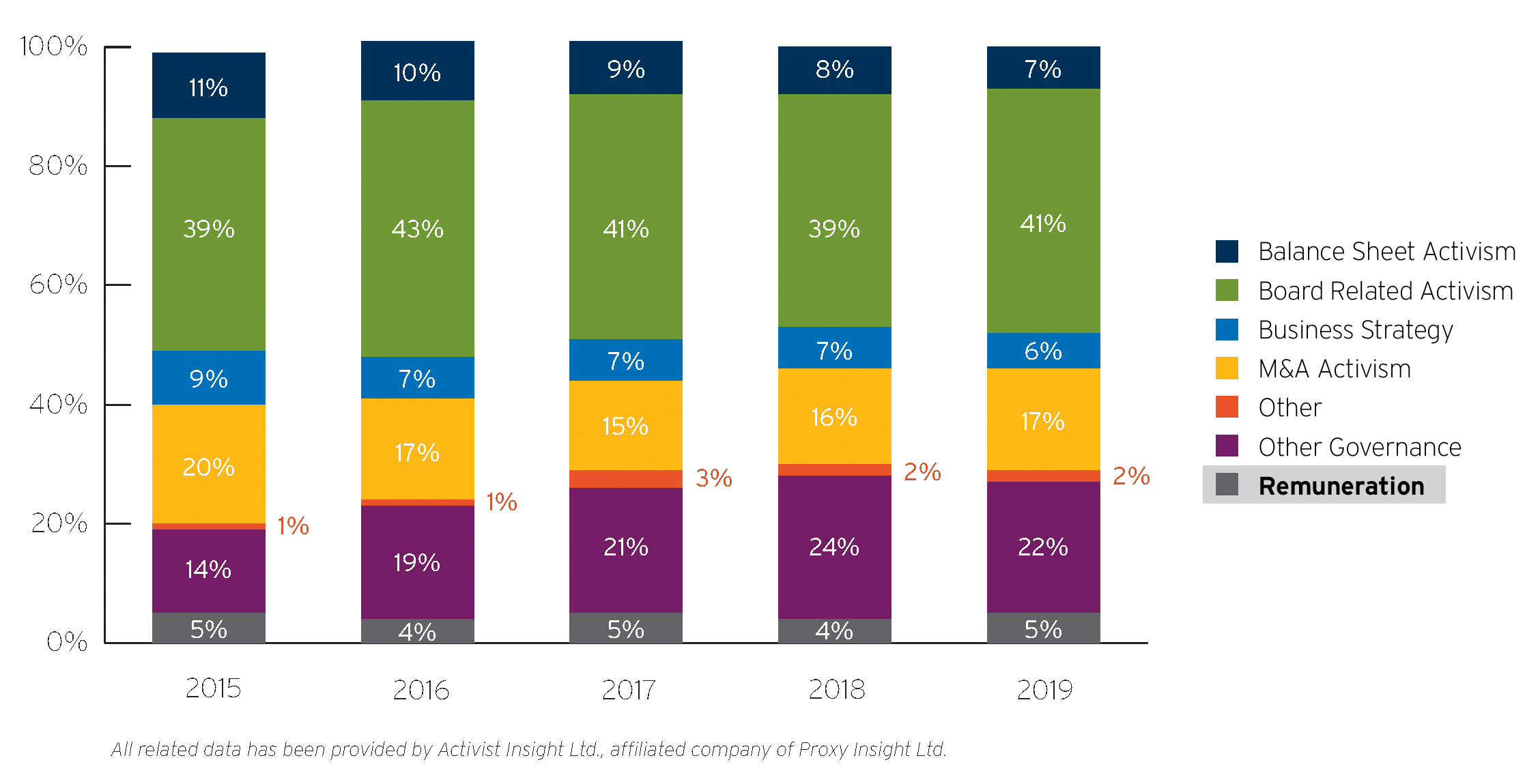
Executive compensation continues to be an area of interest for activist investors. In 2019, 5% of all public activist demands for U.S. companies related to executive compensation.1 Typically these executive compensation-focused activist demands relate to targeting companies that are financially underperforming, but continuing to pay executives at high-performance levels. A company's problematic pay practices can make it an obvious target for activists and can be used as leverage to pursue a larger activist agenda – often related to replacing board members, addressing inadequate business practices, or other areas of performance like cost savings initiatives.
U.S. Public Activist Demands by Type (2015 to 2019)
More activism-related statistics can be found in Georgeson’s 2019
Annual Corporate Governance Review.
Activist Campaigns with a Focus on Executive Compensation
Several companies have recently found themselves targeted by activist investors leveraging executive compensation concerns in their demands. The examples recorded below highlight the importance of getting ahead of executive compensation issues, before an activist approaches:
| Campaign | Outcome |
|---|---|
Progenics Pharmaceuticals / Velan Capital, with other members of its group (Progenics market cap: $354M)2 | The dissidents solicited proxies against Progenics' director nominees and say-on-pay proposal, noting that annual incentives were 100% discretionary, long term incentives were 0% performance based and directors' pay was excessive and egregious. The dissidents nominated six candidates to the board, however Progenics was successful in invalidating the nominees. ISS recommended in favor of the dissident and Glass Lewis recommended in favor of management. Progenics ultimately prevailed in the proxy fight. |
Luby's Inc. / Bandera Partners LLC (Luby's market cap: $23M)2 | Bandera Partners LLC fought to remove the chairman and other directors of Luby's Inc., citing poor stock performance over the past five years, while the company spent $18.3M on board and management compensation during the same period. The campaign went to a proxy fight. While both proxy advisory firms, ISS and Glass Lewis, recommended for Bandera, Luby's management still prevailed in the fight. |
Front Yard Residential Corp / Snow Park Capital Partners (Front Yard market cap: $652M)2 | Snow Park, citing poor decision-making, lack of initiative to address issues, and insufficient shareholder oversight, sought to fill five out of seven board seats at Front Yard. It solicited shareholders to vote against the Equity Incentive Plan and Say on Pay proposals. ISS and Glass Lewis were split, with ISS siding with Snow Park, and Glass Lewis with Front Yard, which ultimately settled, granting Snow Park two seats on the board. |
Bed Bath & Beyond / Legion Partners AM (Bed Bath & Beyond market cap: $606M)2 | Legion Partners, Macellum Advisors and Ancora Advisors declared their intent to nominate 10 directors, publicly criticizing the company's long history of underperformance, seemingly permanent board and excessive compensation package. Ultimately, this did not go to a vote, with Bed Bath & Beyond settling, giving the dissidents four seats on the board. |
Amber Road / Altai Capital Management | When Amber Road rejected E2Open's proposal to buy the company, dissident Altai launched a campaign. Altai cited Amber Road's long term underperformance and excessive CEO compensation pay to support demands to sell the company and oppose director nominations. Ultimately this did not go to a vote, but Amber Road agreed to be acquired by E2Open. |
Executive Pay During COVID-19
While many activist investors seem to have refrained from targeting companies during the COVID-19 health emergency, companies should expect to see an increase in activity in the coming months. To avoid an activist campaign or unsolicited takeover catching you off guard in the aftermath of the pandemic, companies should consider the ways activist investors may view their pay practices. Companies may wish to review their executive pay approaches to determine whether existing terms are appropriate in the context of company performance during the crisis and the impact the pandemic has had on employees.
Shareholder Analysis and Engagement
Understanding and engaging with your investors is a key way to prepare your company for a potential activist scenario; engagement is critical to building credibility amongst all of your investors. Georgeson can help you develop a successful engagement program, creating strategies to engage with shareholders, proxy advisory firms and other relevant parties. Learn more about Shareholder Engagement in an Age of Activism.
If you do find yourself the target of an activist investor, Georgeson can help here too. We provide advisory services to help you gain better control of these situations by identifying and analyzing your shareholder base, modeling predictive vote outcomes, scheduling investor meetings, organizing meetings with proxy advisory firms, running the proxy solicitation process and tracking the flow of proxies and votes.
Learn more about how Georgeson can help you improve your pay practices to prepare for activist investors.
Contact Us
1 Georgeson's 2019 Annual Corporate Governance Review
2 Companies' market cap information: D&B Hoovers. Market cap as of April 29, 2020.